Sagres by wheelchair: what's accessible, what isn't – and the one address where it actually works
Updated September 10, 2026 · 7 min read
This article follows a stricter rule than anything else on this site: it states only what the operator or the municipality says itself – and every time, that you confirm it before you travel. Anyone who writes “it’s fine” when it isn’t leaves someone standing in front of a flight of steps. That’s not a minor slip.
That’s why the most important finding comes first, and it’s an uncomfortable one: not one of the roughly 25 bookable activities in Sagres makes any statement about accessibility in its description. Nothing on wheelchairs, nothing on boarding the boat, nothing on transfers. We checked the entire listing for this. What isn’t stated can’t be looked up – it can only be asked, in writing, before you book.
The fortress: the only site with its own stated commitment
Fortaleza de Sagres is the one place where an official statement exists. The Monumentos do Algarve website states that the monument has accessibility for people with reduced mobility to the historic route, to the headland itself, and to the exhibition centre. Car and coach parking is available.
That’s the operator’s own statement, not our observation. Here’s what you should know so you can judge it correctly:
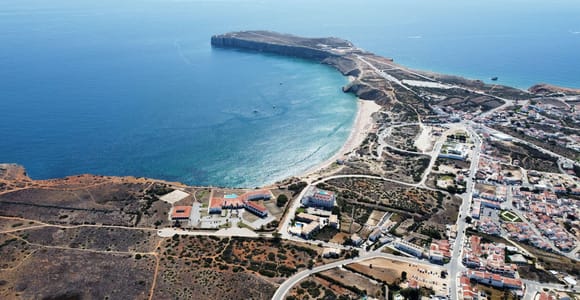
Ponta de Sagres is a headland roughly one kilometre long. The loop path around the outside is accordingly a there-and-back of about two kilometres. It’s flat – but completely exposed: no shade, often strong wind, and the cliff edge isn’t fenced off throughout. In a north wind, a two-hour circuit there is a completely different matter than on a still day.
Admission is 10 €, concessions 5 € (13–24, over 65, family ticket), children under twelve free (as of September 2026). The fortress states that visitors with disabilities and one companion enter free – the ticket office asks for proof. Current information states it’s open daily from 9:30 am, until 8:00 pm in summer. Opening hours and the exact conditions at the entrance, in the tunnel, and on the parade ground are what you should check beforehand – the fortress lists contact details for this at fortalezadesagres.pt. An email a week ahead saves a disappointment on the day. What there is to see there is covered in What to see in Sagres.
Cabo de São Vicente: the car park is the viewpoint
The cape lies six kilometres to the west, and here the situation is different. The ground around the lighthouse is uneven, with steps; several guidebooks explicitly describe the terrain as unsuitable for wheelchairs and pushchairs. There’s no statement from the operators here, unlike at the fortress.
The good news is concrete: parking is free, the car park is up top, and the view of the edge where two seas meet already begins there. You don’t have to walk the loop around the lighthouse to see why people drive out here. There are toilets at the car park for a small fee, around 0.60 €.
If you’re going for sunset: the car park regularly fills up in the hours beforehand, and many people then park along the access road. If you need a space close to the edge, arrive well before.
The beaches: a clear ranking, and an award only one beach holds
This is the section where the differences are greatest – and the reason this article is of any use at all.
Praia da Salema is the answer. The beach lies in the same municipality, Vila do Bispo, about 18 kilometres east of Sagres, roughly twenty minutes by car. In 2026 it’s the only beach in the entire municipality to hold the “Praia Acessível – Praia para Todos” (Accessible Beach – Beach for Everyone) award from the Portuguese Instituto Nacional para a Reabilitação. This includes fixed and flexible walkways across the sand, an amphibious wheelchair, and a shower. The municipality replaced the wheelchair with a new unit in August 2026.
This is the only place in the area where swimming with a wheelchair is provided for and equipped – not just somehow manageable. Whether the wheelchair is available on a given day and whether the bathing season is open is something the Câmara Municipal de Vila do Bispo can confirm. Salema is also on the same bus line 47 that serves Sagres.
Praia do Martinhal, a good two kilometres east of the village, is the most practical beach in Sagres itself: flat, wide, with the car park right behind it, and access described as a ramp plus steps. Several listings describe it as accessible. It doesn’t hold the “Praia Acessível” award in 2026, though. That’s a distinction worth knowing: a short, level path from the car to the sand is a different thing from walkways across the sand, a wheelchair, and staff.
Praia da Mareta, below the village, has around 170 parking spaces and a good access road – but the way down to the beach is via steps. It’s listed as not accessible.
Praia do Tonel is reached via a path cut into the cliff. The car park right at the beach is small; the large one is at the fortress, around 300 metres away.
Praia do Beliche is out. The way down is a long flight of steps.
Which beach otherwise suits whom is covered in Family beaches in Sagres.
Tours: nothing is confirmed, so ask
Boats depart from Porto da Baleeira, the fishing harbour east of the village. What boarding looks like there – jetty, height, steps, whether a transfer is possible – isn’t stated by any operator in its description. The same goes for the 4x4 tours, where transferring into the vehicle would be needed, and for the horse-riding tours inland.
The questions that need clarifying before booking – in writing:
- How do you get on board, or into the vehicle? Are there steps, how many, is there help?
- Can the wheelchair be brought along and stowed securely – and does the operator confirm that?
- Is there a toilet on board? (No description in Sagres mentions one.)
- What happens if the trip is cancelled because of swell – and how is it refunded?
Don’t book anything you don’t have a written answer for. A verbal assurance on the jetty won’t help you once the boat is full. The listings here are small, but so are the operators – which often means a message actually reaches someone who can answer it. The full list is at Things to do in Sagres, and the trips on the water at Dolphin watching in Sagres.
The village itself, and getting there
Sagres is small and mostly flat, and the distances in the village are short. That’s the pleasant part. The less pleasant part: it’s a village that grew up as a fishing settlement, not a purpose-built resort – don’t expect dropped kerbs throughout and level access to every restaurant, and if you have a particular place to stay in mind, confirm door widths and thresholds with the owner, not from photos.
The drive comes via Vila do Bispo, around eight kilometres, then a straight road through open country. By bus, line 47 runs from Lagos via Sagres to Cabo de São Vicente, around an hour from Lagos. Whether the vehicles used have low-floor boarding and a wheelchair space isn’t published by the operator, Vamus, in any form you could rely on – that’s a question for Vamus before you travel, not a detail to find out at the stop.
What Sagres is good for, regardless
The honest summary comes in two parts. For a beach holiday with a wheelchair, Salema is the right address in this area, not Sagres. For the village itself: the fortress and the cape are impressive even if you don’t cover every metre of the loop path – it’s the landscape doing the work here, not the route.
If you can’t walk as far but don’t use a wheelchair, the routes, distances, and step counts are covered in Sagres with limited mobility. More articles are in the guides.