Sagres sights: what's really worth seeing at the end of Europe
Updated October 14, 2026 · 8 min read

Search for things to see in Sagres and you’ll find a short list: a fortress, a headland, a few beaches. The list is accurate. It just doesn’t explain why people make the hour’s drive from Lagos, or the two hours from Faro.
The reason is geographical, and you can verify it on foot in an afternoon: two coastlines meet at Sagres. The south side is the Algarve as you’d expect it – sheltered bays, swimmable water, boats setting off in the morning. The west side is open Atlantic, with swell, wind and cliffs. Twenty minutes’ walk separates the two. No other place on this coast puts both so close together.
The town itself is a village. One roundabout, two supermarkets, surf shops, a working fishing harbour, and restaurants that mostly don’t have a sea view. If you’re after an old town or a seafront promenade, Sagres is the wrong choice, and you’ll know it within the first quarter of an hour. People come here for the edge.
The Fortaleza de Sagres – and what’s left of the legend
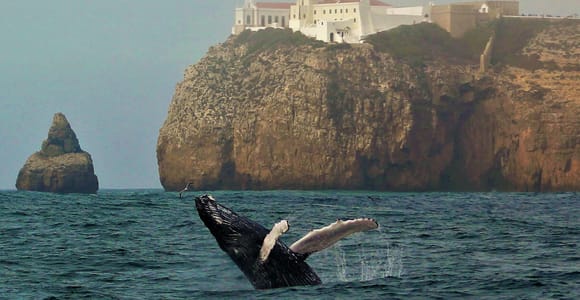
The Fortaleza de Sagres stands on the Ponta de Sagres, a headland roughly one kilometre long and about 300 metres wide, whose cliffs drop some 40 metres straight into the water. You enter through a wall, and beyond it lies an expanse where there’s little besides grass, a path and a drop.
The best-known feature is the Rosa dos Ventos, a stone pattern set into the ground, 43 metres across, uncovered in the 1920s. Whether it was a wind rose, a sundial or the outline of an earlier building is still disputed. That’s exactly what makes it more interesting than a settled explanation would.
Also disputed, and far more stubborn: the “navigators’ school of Henry the Navigator”. Many guidebooks and several information boards in the area state it as fact. There’s no solid contemporary evidence for a school or an observatory at this site; historians largely regard the story as a later attribution. That Henry held property at Sagres, and that voyages set out from this coast, is not in question – the academy is. If someone on site tells you otherwise, you now know why.
In practice: the fortress opens daily at 9.30am and closes at 5.30pm between October and April, and at 8pm between May and September, with last entry half an hour before. Admission is €10, with a €5 concession for 13- to 24-year-olds, visitors over 65 and family tickets, and free entry for children under twelve – and the ticket office is always right, not this article. The price more than tripled in early 2025; older guidebooks and blog posts still quote the old one. A walk round takes half an hour to a good hour, depending on your pace.
One tip about tickets: booking portals sell an entry ticket from €10 – which is exactly the box-office price, so there’s nothing to save either way. If you buy at the gate, bring cash: the fortress itself warns that card payment is intermittently unavailable. The online ticket mainly makes sense as part of a guided tour.
And a tip that saves trouble: there’s no shade on the headland, and for long stretches no barrier at the edge. In windy conditions, this is not a relaxed place with small children – more on that in Sagres with a Toddler.
Cabo de São Vicente, six kilometres further on
The headland is the south-westernmost point of mainland Europe and the area’s real attraction. It’s about six kilometres west of Sagres, the road leads straight there, and parking is free – though the car park regularly fills up in the hours before sunset, so many people end up parked along the access road.
The site itself is freely accessible and not bound by opening hours. The lighthouse, built in 1846, has stood there for generations; its interior can’t currently be visited. If that matters to you, check shortly before you go rather than relying on anything you read online – including this.
What you actually see: a cliff edge where two seas meet, cargo ships rounding the corner far out at sea, and, on a clear day, a view no description quite captures. What you also see: anglers standing where no one should, and visitors sitting in the same spots for a photo. The cliffs aren’t fenced off along their whole length.
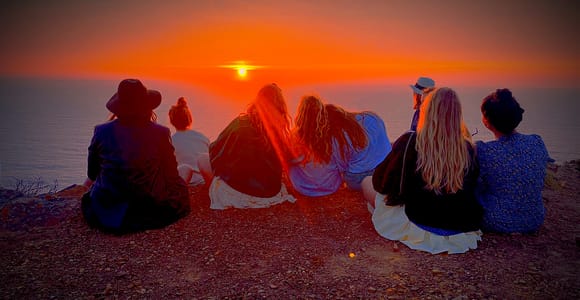
Sunset at the headland is why most guided tours end here. It’s famous for good reason, and correspondingly busy in summer. If you want it quieter, come in spring or autumn.
Four beaches, two different seas
The beaches aren’t an afterthought – they’re where Sagres’s location actually makes sense. All of them are within easy reach, and each behaves completely differently.
Praia da Mareta lies below the town, facing south and framed by rocky outcrops. This is the beach for an ordinary day’s swimming: the shortest walk, the calmest water of the four, and correspondingly crowded in summer.
Praia do Tonel lies on the other side of the same headland, facing west. The full Atlantic stands in front of it, and you can tell from the surf. A surfing beach, not a paddling one.
Praia do Beliche lies between Sagres and the headland, beneath high cliffs that block off some of the swell. The way down is a long flight of steps, which keeps the beach quieter than the others. It’s not an option for anything on wheels.
Praia do Martinhal lies a good two kilometres east in the Baía da Baleeira and is the most sheltered of the four. Shallow, wide, family-friendly – and so it gets fuller treatment in Sagres with Kids.
One sentence that can rescue a day’s holiday: if it’s unpleasantly windy in town, that’s often just the west side. Two kilometres away at Martinhal, it can be still at the same time. And the other way round.
Why the water is colder than 100 kilometres further east
This is the detail most pages leave out, and the one visitors are most often surprised by. Off the west Algarve, the prevailing north-westerly wind pushes the warm surface water out to sea, and cold water rises from below – a process that needs two or three days of sustained wind and can drop the water temperature by several degrees even at the height of summer.
In practice that means: while the south coast reaches 22–23 °C in August, Sagres stays below that. The warmest month here isn’t August but September, averaging a good 21 °C. Anyone expecting bath-warm water in July gets the shock on day one.
For most activities that’s not a problem, because wetsuits are provided – on the surf course as a matter of course, and on coasteering too. For a beach holiday with small children, it’s information worth having before you book.
What gets booked here – and what doesn’t exist
The range on offer is modest, and that’s more honest than a long list: Sagres has around 25 listings, from €10, with a median of €65, and just over 2,100 reviews between them. That’s a fraction of what Portimão or Albufeira offer. In return, almost every listing is tied to the landscape, because there’s nothing else here to sell.
The most heavily reviewed are the sunset jeep tours to the headland – the town’s most-reviewed tour stands at 4.8 stars from 459 reviews and costs €63. A version without the jeep, the minivan half-day tour from Lagos, costs €59.
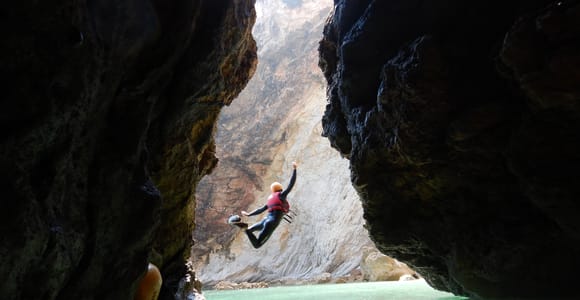
Right behind it is coasteering: swimming, climbing and cliff-jumping along the rocky coast, with wetsuit and helmet, in two versions from €60 and €63 respectively, both rated between 4.9 and 5 stars across around 470 reviews combined. This is not a stroll, and an operator claiming otherwise would be the wrong one.
On the water, the boats leave from Porto da Baleeira, the fishing harbour east of the town. From there it’s out past the headland, where dolphins are sought in the open Atlantic rather than a sheltered bay – a trip combining dolphins and sea caves costs €65, and the longer wildlife trip with a chance of whales costs €95. Full details are on the overview Dolphin Watching in Sagres. Whether a trip like this suits your child is a separate question: Boat Trips with Kids – What’s the Minimum Age?
On land there’s a surf course for €75, a stand-up paddleboard tour with snorkelling at the caves near Ingrina for €58, and horse-riding trips inland – the ride near Carrapateira has 5 stars from 360 reviews and costs €70. The full list is at Things to Do in Sagres.
What you won’t find here: no water park, no aquarium, no boat trip to Benagil Cave (that’s a good 60 kilometres east, and runs out of Portimão or Lagos), no nightlife beyond a handful of bars. If that’s what you’re after, use Sagres as a day trip rather than a base.
October isn’t a bad month, it’s the best
Sagres sits on one of Europe’s major migration routes. From August to October, birds of prey gather at this headland before moving on across the strait; the busiest stretch runs from the last week of September to the first week of October. The best-known viewing point is at Cabranosa, between the town and the headland. A multi-day birdwatching festival takes place there in early October.
Even if you’re not here for the birds, you still benefit: the water is warmest in September, the wind eases off, and the tours are still running.
How long to stay?
A full day covers the fortress, the headland and one beach. If you also want a boat trip or coasteering, allow two to three. If you want to take in the west coast heading north – Carrapateira, Aljezur, Odeceixe – plan for a week, and read on at What to See on the Costa Vicentina.
And if you only have an afternoon: skip the fortress, drive to the headland, then head to Mareta. That’s the honest short version.
You’ll find more articles on Sagres in the guides.