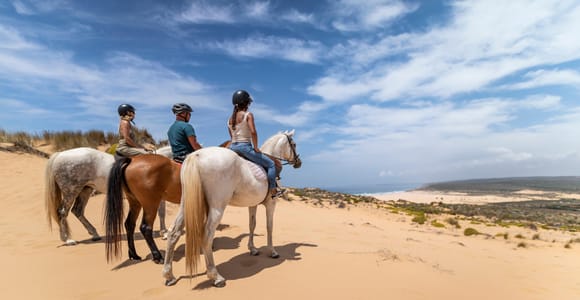
The one drive worth doing from Sagres: the west coast to Carrapateira
Updated September 19, 2026 · 9 min read

If you hire a car here for two days, this is what the first one is for. Not a list of viewpoints spread over the whole Algarve, but one road, going north, on the side of the peninsula where the Atlantic arrives unbroken.
The route is Sagres – Cabo de São Vicente – Vila do Bispo – Carrapateira, with Praia da Bordeira and Praia do Amado at the end of it, and an optional continuation to Aljezur. It is the drive the bus effectively cannot do. Route 47 runs east to Lagos and reaches the cape three times a day, and stops there. Vamus route 22 does cover Vila do Bispo to Aljezur via Bordeira and Carrapateira – but the independent Algarve timetable archive records it as running Mondays and Fridays only, outside holidays, which makes it a lifeline for residents rather than a way to spend a Wednesday.
The legs, measured
All figures below are road distances and driving times, not straight lines.
Sagres → Cabo de São Vicente — 6.0 km, about 7 minutes. Go early or go late; the middle of the day at the cape in summer is a car park and a coach. There is a car park at the lighthouse. What is currently open there and what is not is covered in Cabo de São Vicente – go and read that before you plan the stop, because the lighthouse itself is not the thing to plan around.
Cabo → Vila do Bispo — 15.6 km, about 17 minutes, back past Sagres and north on the N268. Vila do Bispo is not a sight, it is the junction: it is also the last of the six filling stations in this municipality before the road empties out.
Optional detour: Praia do Castelejo and Praia da Cordoama, west of Vila do Bispo, about five kilometres. Two of the most striking beaches on this coast, with car parks behind them. Be aware that descriptions of the approach differ – the Castelejo road is consistently described as narrow and winding, and the final stretch onward to Cordoama is described by some sources as surfaced and by others as a dirt track. We have not driven it to settle the question, so treat it as a detour to ask about locally rather than one to commit to in a low hire car.
Vila do Bispo → Carrapateira — 14.6 km, about 17 minutes on the N268. This is the best stretch of the drive: the road runs inland of the cliffs through low scrub with the sea appearing and disappearing on your left.
Carrapateira → Praia da Bordeira — 0.7 km. A beach with a lagoon behind it, a car park and a boardwalk down from the cliff to the south.
Carrapateira → Praia do Amado — 3.1 km, about 7 minutes. The surf beach, with a car park above it. If anyone in the party is learning, this is one of the beaches the Sagres schools drive to – see choosing the beach for a surf lesson.
Turn round here and you have done about 70 km and half a day. Carry on and it becomes a full one.
Carrapateira → Aljezur — 20.9 km, about 23 minutes. A proper small town with a castle above it, and the point where the coast stops being an excursion and starts being a region. Aljezur → Sagres direct is 43.8 km, about 46 minutes, so the full loop comes to about 105 km.
Fuel: the advice you will read is wrong here
Every guide to the far west tells you to fill up before you head out because Sagres is remote and expensive. The official price register says otherwise.
Portugal’s DGEG publishes what every station charges. In the week to 19 September 2026, the six stations in the municipality of Vila do Bispo were listed at €1.998 to €2.184 a litre for 95 unleaded – and the cheapest of them, the Intermarché in Sagres, was below the station at Faro Airport (€2.093) and below twelve of the thirteen stations in Lagos. You are not paying a remoteness premium in Sagres. You are paying one if you fill up in the wrong part of it.
What is true is the gap. Between Vila do Bispo and Aljezur – the whole 35-kilometre middle of this drive, Carrapateira included – the register lists no filling station at all. It is not a distance that will strand anyone. It is a good reason not to start the day on a warning light.
What the last few hundred metres are made of
This matters more than the route itself, and it connects directly to your rental agreement.
Praia da Bordeira and Praia do Amado both have car parks and both are reached from Carrapateira on surfaced road. The short links between the beaches and some of the parking areas on this coast are loose surface, and the most ordinary things that happen to a car here are a stone chip in the windscreen and a punctured sidewall.
Which is exactly the gap in the cover most people buy. One Algarve operator’s terms put it in a single sentence: damage to tyres, windows and locks is not covered by CDW, RDW or SuperCDW, only by a separate TLW. The full picture is in excess, deposit and what the counter adds; the short version is that the package which sets your excess to zero may still leave you paying for a windscreen.
Two practical habits, neither of them heroic: park on the surfaced part rather than the last metre of gravel, and walk the extra fifty metres. And if the map offers you a shortcut that is clearly a track, take the long way round – several rental agreements exclude damage from “improper use of the vehicle”, and a sand track is an argument you do not want to have at the return desk.
The rules you are driving under
Portuguese general speed limits, from article 27 of the Código da Estrada: 50 km/h in built-up areas, 90 km/h outside them, 120 km/h on motorways. The N268 is an ordinary road, so it is 90 unless signed otherwise, and there are villages along it where it drops to 50 without much ceremony.
The alcohol limit is 0.5 g/l, and 0.2 g/l for drivers in their first three years with a licence and for professional drivers. Which is the honest reason the wine tour is a tour: the Sagres Wine Escape is a four-and-a-half-hour programme, and whoever drives it drinks nothing.
When the guided tour is simply better
Three cases, and none of them is a sales pitch.
If you want the sunset at the cape and a glass of something. The jeep tour through the natural park costs €63 for four hours and is the most-reviewed activity in our Sagres selection, with 459 ratings. Somebody else deals with the track, the light and the drive home.
If you want the coast explained rather than just crossed. The seven-hour coastal tour at €135 covers considerably more ground than this drive does, with a guide; what it does and does not name along the way is in the full-day coast tour.
If you are two people for one day only. Two seats on the €63 jeep tour is €126 – less than a day’s hire, fuel and the collection trip to Lagos or Faro. The car wins over several days, not over one. That calculation, with the point where it flips, is in private or group tour in Sagres.
Summer and winter are different drives
In July and August the beach car parks at Amado and Bordeira fill, and they fill from mid-morning. The cape is worst between about eleven and four. The drive is the same; the standing around is not. Go north first and do the cape on the way back in the evening.
In November to March the road is empty and the coast is at its best, but the daylight is short, several beach cafés are shut and the wind that makes this coast what it is arrives with rain behind it. The seasonal picture is in the best time to visit Sagres.
One thing does not change with the season: this is the direction worth driving. East of Sagres the coast is served by boats, and the boat trips leave from a harbour you can walk to.
Compare car hire for Sagres and the western Algarve
More articles are in the guides.